


![IMG_0342[1]](https://i0.wp.com/starvinlarry.com/wp-content/uploads/2014/12/img_03421.jpg?w=325&h=243&ssl=1 "IMG_0342[1]")


Archive for the ‘Uncategorized’ Category
Guerrilla Radio: Getting Your Local Station Running
Posted: May 15, 2018 by gamegetterII in Uncategorized
 Originally posted over at American Partisan. Come check us out- lots of good liberty-oriented material getting posted daily.
Many of the questions I get on a day-to-day basis revolve around what equipment is needed to get a radio station up and running with minimal cost. That’s a tough question and one that’s even tougher when you don’t know where to begin. A lot of survivalist and prepper-oriented folks getting their feet wet think that commo begins and ends with a handheld radio – and while that might work within a family farm of a couple dozen acres or even over a small town with a repeater, a group can do so much more, reliably, with a better base station. In addition, a repeater should never be part of your communications plan. It’s another point of failure that decreases the robustness of your communications. For those starting out I highly recommend…
View original post 969 more words

“Whether the mask is labeled fascism, democracy, or dictatorship of the proletariat, our great adversary remains the apparatus—the bureaucracy, the police, the military. Not the one facing us across the frontier of the battle lines, which is not so much our enemy as our brothers’ enemy, but the one that calls itself our protector and makes us its slaves. No matter what the circumstances, the worst betrayal will always be to subordinate ourselves to this apparatus and to trample underfoot, in its service, all human values in ourselves and in others.”—Simone Weil, French philosopher and political activist
We labor today under the weight of countless tyrannies, large and small, carried out in the name of the national good by an elite class of government officials who are largely insulated from the ill effects of their actions.
We, the middling classes, are not so fortunate.
We find ourselves badgered, bullied and browbeaten into bearing the brunt of their arrogance, paying the price for their greed, suffering the backlash for their militarism, agonizing as a result of their inaction, feigning ignorance about their backroom dealings, overlooking their incompetence, turning a blind eye to their misdeeds, cowering from their heavy-handed tactics, and blindly hoping for change that never comes.
The overt signs of the despotism exercised by the increasingly authoritarian regime that passes itself off as the United States government are all around us: warrantless surveillance of Americans’ private phone and email conversations by the NSA; SWAT team raids of Americans’ homes; shootings of unarmed citizens by police; harsh punishments meted out to schoolchildren in the name of zero tolerance; drones taking to the skies domestically; endless wars; out-of-control spending; militarized police; roadside strip searches; roving TSA sweeps; privatized prisons with a profit incentive for jailing Americans; fusion centers that collect and disseminate data on Americans’ private transactions; and militarized agencies with stockpiles of ammunition, to name some of the most appalling.
Yet as egregious as these incursions on our rights may be, it’s the endless, petty tyrannies inflicted on an overtaxed, overregulated, and underrepresented populace that occasionally nudge a weary public out of their numb indifference and into a state of outrage.
Consider, for example, that federal and state governments now require on penalty of a fine that individuals apply for permission before they can grow exotic orchids, host elaborate dinner parties, gather friends in one’s home for Bible studies, give coffee to the homeless, let their kids manage a lemonade stand, keep chickens as pets, or braid someone’s hair, as ludicrous as that may seem.
A current case before the Supreme Court, Niang v. Tomblinson strikes at the heart of this bureaucratic exercise in absurdity that has pushed overregulation and overcriminalization to outrageous limits. This particular case is about whether one needs a government license in order to braid hair.
Missouri, like many states across the country, has increasingly adopted as its governing style the authoritarian notion that the government knows best and therefore must control, regulate and dictate almost everything about the citizenry’s public, private and professional lives.
In Missouri, anyone wanting to braid African-style hair and charge for it must first acquire a government license, which at a minimum requires the applicant to undertake at least 1500 hours of cosmetology classes costing tens of thousands of dollars.
Tennessee has fined residents nearly $100,000 just for violating its laws against braiding hair without a government license.
In Oregon, the law is so broad that you need a license even if you’re planning to braid hair for free. The mere act of touching someone’s hair can render you a cosmetologist operating without a license and in violation of the law.
In Iowa, you can be sentenced with up to a year in prison for braiding hair without having attended a year of cosmetology school.
It’s not just hair braiding that has become grist for the overregulation mill.
Almost every aspect of American life today—especially if it is work-related—is subject to this kind of heightened scrutiny and ham-fisted control, whether you’re talking about aspiring “bakers, braiders, casket makers, florists, veterinary masseuses, tour guides, taxi drivers, eyebrow threaders, teeth whiteners, and more.”
For instance, whereas 70 years ago, one out of every 20 U.S. jobs required a state license, today, almost 1 in 3 American occupations requires a license.
The problem of overregulation has become so bad that, as one analyst notes, “getting a license to style hair in Washington takes more instructional time than becoming an emergency medical technicianor a firefighter.”
This is what happens when bureaucrats run the show, and the rule of law becomes little more than a cattle prod for forcing the citizenry to march in lockstep with the government.
Overregulation is just the other side of the coin to overcriminalization, that phenomenon in which everything is rendered illegal and everyone becomes a lawbreaker.
This is the mindset that tried to penalize a fisherman with 20 years’ jail time for throwing fish that were too small back into the water.
John Yates, a commercial fisherman, was written up in 2007 by a state fish and wildlife officer who noticed that among Yates’ haul of red grouper, 72 were apparently under the 20-inch minimum legal minimum. Yates, ordered to bring the fish to shore as evidence of his violation of the federal statute on undersized catches, returned to shore with only 69 grouper in the crate designated for evidence.
A crew member later confessed that, on orders from Yates, the crew had thrown the undersized grouper overboard and replaced them with larger fish. Unfortunately, they were three fish short.
Sensing a bait-and-switch, prosecutors refused to let Yates off the hook quite so easily. Unfortunately, in prosecuting him for the undersized fish under a law aimed at financial crimes, government officials opened up a can of worms. Thankfully, the U.S. Supreme Court in a rare (and narrow) flash of reason, sided with Yates, ruling that the government had overreached.
Read More @ The Rutherford Institute-( https://www.rutherford.org/ )- here
Buckeye Firearms Association Threatens to Sue if Cincinnati Bans Bump Stocks
Posted: May 11, 2018 by gamegetterII in UncategorizedCincinnati City Council passed a motion Wednesday asking the city administration to draft an ordinance banning bump stocks. Such a law would be a clear violation of Ohio state law, which overrides home rule on the matter of firearms.
R.C. 9.68, Ohio’s “preemption” law, became effective in March of 2007. It replaced a patchwork of varied and confusing local rules with “uniform laws throughout the state regulating the ownership, possession, purchase, other acquisition, transport, storage, carrying, sale, or other transfer of firearms, their components, and their ammunition.”
The motion is not enforceable law at this point, so bump stocks are still legal. However, if an ordinance is passed, it would be a direct challenge to R.C. 9.68.
“Preemption has been tested,” said Dean Rieck, Executive Director of Buckeye Firearms Association. “The cities of Cleveland and Clyde have tested the law and lost in court. It’s gone all the way to the Ohio Supreme Court.
“I don’t know what Cincinnati City Council is thinking,” Rieck continued, “but I’ll tell you what we’re thinking. Our organization protects the rights of 4 million Ohio gun owners. And if the city follows through and puts a ban into to their municipal code, our Foundation will file a complaint and take the city to court. They’ll lose. And they’ll pay legal costs which is mandated by state law. Do Cincinnati taxpayers really want that?”
A major Ohio city has already gone down this path and lost. Cleveland challenged the preemption law and, in 2010, the Ohio Supreme Court ruled against them in a 5-2 opinion, saying that Ohio’s preemption law is valid in all respects, including, but not limited to, the mandatory attorney fee provision.
“This really isn’t about bump stocks,” said Rieck. “It’s about the rule of law in Ohio. Cities can pass all kinds of laws. But they can’t pass gun laws. This was decided more than a decade ago. We thought everyone understood that by now, but apparently not. So if we have to sue to once again to make the point, that’s exactly what we’ll do.”
Rieck says he urges gun owners to start attending Cincinnati City Council meetings to voice their strong opposition to this potential ban.
Buckeye Firearms Association is a grassroots organization dedicated to defending and advancing the right of citizens to own and use firearms for all legal activities, including self-defense, hunting, competition, and recreation.
Buckeye Firearms Foundation is a 501(c)(3) charitable organization that, among other things, funds legal defense to defend gun owners against infringement of rights and litigation to force local governments and other entities to comply with Ohio gun laws. Read more.
Via Buckeye Firearms Association here

Last August, I announced the start of a new project focused on understanding “Low Intensity Conflict” because that’s what probably best describes the future of the United States. That was eight months ago and I surmised that our domestic conflict had already started, although at a very low level. Today I want to address some open ends of that first post and describe what I believe political violence will look like in the future.
One reason why I stopped using the term “civil war” is a) because it’s very vague, and b) because I’m not sure that we’ll actually have an outright civil war. Of course, we might, but I’m less sure of that than I am that we’ll have a domestic conflict marked by political and tribal violence, disestablishment of the rule of law, and maybe regional independence movements. As opposed to a conventional, force-on-force conflict, we’re much more likely to experience irregular, tribal warfare referred to as “Low Intensity Conflict”.
FM 100-20, Military Operations in Low Intensity Conflict (1990, which I believe is no longer valid), provides us an official definition of the term:
Low intensity conflict is a political-military confrontation between… groups below conventional war and above the routine, peaceful competition… It frequently involves protracted struggles of competing principles and ideologies. Low intensity conflict ranges from subversion to the use of armed force. It is waged by a combination of means, employing political, economic, informational, and military instruments. Low intensity conflicts are often localized, generally in the Third World, but contain regional and global security implications.
Earlier this week, an acquaintance told me flat out, “It will never happen”. Well, it’s already happening. “Punch a Nazi” and “Bike lock your local red hat” are maxims of political violence that perfectly describe low intensity conflict (LIC). It’s not outright war; there’s no widespread, daily fighting in the streets to gain territory or expand borders. It’s really more akin to gang or tribal conflict than it is to traditional war. And that’s exactly what LIC is. The organizing being done on the Far Left and Far Right are a precursor to conflict waiting for a flashpoint or catalyst. The militias on the Right and the radicals and revolutionaries on the Left have organized for decades. They’re here, they’re angry, their views of American history and their desired future are inimically opposed, and there could absolutely be a tipping point that, in their eyes, demands violence. This is not an analytical leap because this type of violence is already happening, just at a very low level. The real leap, however, is to view these indicators and their exhibited desire to commit violence on behalf of their ideology, and then say or believe that things are going to get better instead of worse. I’m seriously interested in the case for how and why political, racial, and social wounds are more likely to heal than worsen, and how and why our political divide is more likely to be bridged than widened.
Read the rest @ Forward Observer here
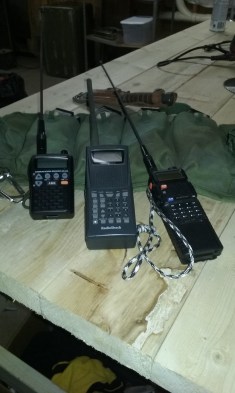 In the RTO Course we spend the bulk of our time on basic skill building- operator technique, antenna types and construction, planning and report formats for sending information rapidly and accurately. It’s a starting point, covering the basics in two days. With that said, one of the common questions I get is regarding the length of the reports when they’re sent. If interception is a concern, and it always is, how do we shorten this up or obscure it to the point of being useless to listen to? There’s a few answers to this question, including going high tech/more complicated/more expensive with equipment, more efficient antenna construction for directivity, and finally, creating a BREVMAT.
A Brevity Matrix, or BREVMAT, is a randomly generated series of codes that are commonly understood by your group and shorten the transmission. In the amateur radio world we use Q codes, and 10 codes are…
View original post 246 more words
 Starvin Larry