Flood Control

Posted: September 4, 2015 by gamegetterII in Uncategorized

Dialing vs. Holdover for Long Range Hunting

Posted: September 4, 2015 by gamegetterII in Uncategorized

By James McClellan Jr.

In our world of long range hunting and shooting there is an ongoing debate: Should I dial or should I hold? The answer depends on the situation. Each method has advantages and disadvantages depending on the circumstances. For very fast shot opportunities at close to medium range, holding is quick and may be accurate enough for big game. For very long shots, there is usually more time to set up, and dialing provides much greater precision in our firing solution.

Let us examine the closer shot situation first. I use a base zero of 200 yards for my 280AI, and my scope, a Vortex Viper HSLR FFP, has an MOA reticle with hashmarks spaced at 2moa intervals vertically. The load is 168 grain Berger at 3015 fps. The drop data that follows is based on 1000 feet above sea level and 55 degrees, generated on my Applied Ballistics phone app. For any shot from fistfight to 225 yards, the center of the reticle will land the bullet in a good spot. For 250 yards, I ought to hold halfway between center and the first mark. For 300 yards, the first mark is almost dead on. 350 yards is halfway between the second and third mark, 400 is almost exactly the third mark.

Absent a hard wind, these aiming points will give me decent hits on deer size targets IF I can remember where to aim in the heat of the moment. I don’t mind admitting that I am the weak link in this system. How well I can settle my eye on the correct point of the reticle is another variable, and looking at a nice sized buck isn’t going to help my concentration. Having a diagram of the reticle marked with the holdovers can help, but it is actually easier for me to remember a number to dial the moa than to memorize a whole pictorial representation- especially if the hold is supposed to fall between marks instead of on one.

As a practical matter, if we think of the kill zone of a deer as a circle of approximately 10 inches diameter, at 400 yards or less we can be a little imprecise with the hold and still get an ok hit. If the wind is up, 10mph is 2.1 moa full value, so shading into the wind to the first hash (the horizontals are at 1moa intervals) will keep the bullet on target. I have used reticle holds on steel at the local range out to 700 yards, but I am not comfortable with the holdover method past 400 if the target has hair.

Dialing vs. Holdover for Long Range Hunting

440 yards, wind 10mph /5moa up/2moa wind, both holding

Dialing vs. Holdover for Long Range Hunting

Same shot, dialed up, holding wind.

Dialing vs. Holdover for Long Range Hunting

Read the rest-(2 more pages)- @ Long Range Hunting

Same shot, all dialed.

Porretto: Destroy The Niche

Posted: September 4, 2015 by gamegetterII in Uncategorized
Via  MassPrivateI
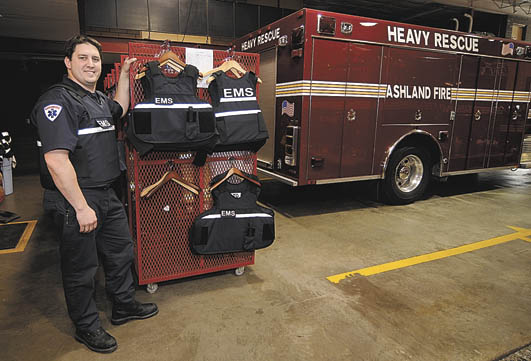
image credit: Times Gazette

Soon EMS & firefighters everywhere will respond to a fire or accident wearing Kevlar helmets and ballistic vests!

‘They’ (DHS) claim having such gear available will help medical personnel get inside a shooting scene quicker to treat the wounded.

What’s really scary is EMS & firefighters are conducting joint training sessions with police.

In June of this year I warned everyone how DHS has begun training EMS and firefighters for urban warfare in America:

DHS’s new “First Responder Guide For Improving Survivability In IED or Active Shooter Incidents”
describes in great detail how firefighters and EMS personnel are being trained by DHS to work alongside law enforcement.

In it’s “First Responder Guide” DHS claims active shooter incidents and IED’s in America are increasing.

A collaborative group of public safety organizations—including fire, law enforcement, pre-hospital care, trauma care, and the military—convened in Hartford, Connecticut, in the spring of 2013 to develop consensus regarding strategies to increase survivability in mass-casualty shootings commonly referred as the Hartford Consensus.

New Hampshire is conducting its first joint training session with police and emergency medical services crews involving handling an active shooting scene and treating victims quicker.

“It goes over law enforcement tactics and the response to a shooter, as well as a new concept that is a best practice of what we call warm zone EMS, which is law enforcement securing the area in a building and allowing EMS to get into a building to treat patients quicker than waiting to search the whole building and deem the whole thing clear,” said Emily Martuscello, an exercise training officer with New Hampshire Homeland Security and Emergency Management.

How long before EMS/firefighters arrive at a vehicle accident or a fire in a tank wearing guns, Tasers and mace? It’s already happening…

Updated 9/2/2015:

Chief Tim Holman of the German Township Fire Dept in Clark County, Ohio, is considering the merits of allowing concealed carry for ambulance crews. Chief Holman addressed the issue at last year’s EMS World Expo in a presentation entitled, “Is It Time We Arm Our EMTs?” (please read the comments in the article)

Should Paramedics Carry Guns Deep In The Heart Of Texas?

Fire department may give firefighters, EMTs guns in face of rising violence.

Police shoot middle school kids during ‘TEMS’ active shooter drills with EMS and firefighters.

Ohio Medics Carrying Guns for Personal Protection:

“For about a year, the Bethel Township Fire and EMS Department has allowed first responders to carry concealed weapons on emergency calls as a way to protect themselves in an area where having law enforcement respond to calls in a timely manner when needed can be a challenge due to reduced staffing.”

“The idea to let first responders carry weapons was hatched after budget cuts reduced the number of available officers in the response area served by the department, says Bethel Township Fire and EMS Department Chief Jacob King.”

Proposal would allow Georgia firefighters to carry guns:

“Rep. Kevin Cooke, R-Carrollton, introduced a bill Thursday, called House Bill 807, co-signed by several other House members, to permit firefighters to carry firearms while on duty, if they wish, and if they have the permission of their superior officers.”

Armed Tactical EMS Team Responds with SWAT in Hot Zones:

“Team members completed 40 hours of initial training from instructors Hammonds and Ashley Tordiff of the Collins Career Center Law Enforcement Academy, including courses in self-defense, legal aspects of tactical EMS, firearms recognition, advanced firearms, self-aid/buddy aid and an Ohio concealed carry permit class.”

Training for the TEMS unit continues following certification and is ongoing. Every week the team participates in realistic simulations with the Lawrence County SWAT team.

Firefighters carrying guns on the job:

“There are several departments who allow selected staff to carry a firearm and most of those are Fire Marshals and are generally commissioned officers with the police powers to arrest and even those individuals get into trouble if they misuse their weapons.”

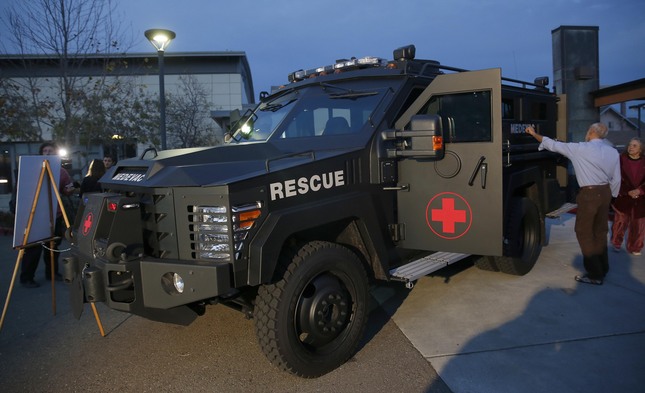
Police in California want to use an armored tank or a medevac vehicle to respond to accidents, etc.

image credit:Contracostastimes

“About 100 people attended a meeting in San Leandro and people from the community expressed their concerns about a medevac vehicle the San Leandro Police Department says it wants to acquire.”

“The armored vehicle was the subject of the special San Leandro City Council meeting. Police officers from the region said the vehicle would enable paramedics to help victims trapped in a hot zone, since EMS doesn’t go into a hot zone unless it’s been cleared. The medevac is able to withstand a rifle round, but is also equipped like an ambulance on the inside.” 

What are Hot, Warm and Cool zones? DHS/police have created these three “zones”  to justify arming EMS & firefighters. Click here & here to read more.

Read the rest Here

Via Kit Lange The Patrick Henry Society

We patriots are often found debating the finer points of Constitutional amendments and/or concepts embodied in Liberty.  One of the greatest of these—and one of those with some of the most widely used derivatives—is the idea that someone is innocent until proven guilty.  We understand this in an abstract sense.  It’s a cliche; you don’t have to be a Constitutional scholar to have heard the phrase.  It’s only been part of the opening credits for the show Cops for two decades.  But what does it really mean?  And why are patriots some of the first people to trash it in application?  Simple:  Because we are human…and maybe, because there’s an application for the concept that most people don’t even think about.

Innocent until proven guilty.  It’s the foundation of our entire court system, our entire justice system.  When someone is charged or even accused of a crime, the burden of proof lies with the entity making the accusation.  It does not lie with the accused.   This ties in with another phrase most people are familiar with: beyond a reasonable doubt.  In other words, people cannot be convicted of a crime unless the jury (or judge in some cases) is convinced beyond a reasonable doubt that the guilt was proven.  An accused person cannot be convicted because a jury thinks, “Gee, it sounds plausible,” or because one of the witnesses is their buddy who they’ve known for 20 years and trust implicitly.  In fact, one of the basic ways to get excused form a jury is to know or be related to any of the parties in the case.  Quite frankly, the system is meant to be stacked in favor of the accused, and this theoretically protects innocent people from being convicted frivolously or targeted by a government looking to silence them for some reason.  We know, of course, that in practice the concept is in shambles, but that’s another issue.

Yes, yes, I know all this, you say.  Why am I giving a primer on law when I’m not a lawyer? Here’s why: because the idea that someone accused of something is innocent until proven guilty gets thrown out the window far too often when dealing with interpersonal relationships in our prepper groups and III% units.  How many times have we seen a group implode due to accusations, drama, and mudslinging fests that rival a political campaign?  All over social media, all over the blogs…some of these groups seem to thrive on the drama.  He said and she said and oh did you hear what so-and-so posted?  One person makes accusations, and then the accused party runs to their own blog or Facebook page to answer those accusations and—if they’re into the flinging poo thing—level a few of their own.  Right about this time, someone starts making popcorn because a third party (usually a friend of one side or the other) decides to weigh in.  More blogs, more division, more BS.  After a while, not only is everything still unresolved, but the surrounding populace is sick to death of hearing about it.  In some cases there is permanent damage to the charity, cause or endeavor that the entire group had set out to contribute to, not to mention irreparable harm to reputations and credibility.

Read the rest @ The Patrick Henry Society

Via CNN

kenneth cole backlash billboard

The American Psychiatric Association slammed the fashion designer on Thursday for a billboard that read: “Over 40M Americans suffer from mental illness. Some can access care…All can access guns.”

The message was signed “Kenneth Cole” and included the hashtags #gunreform and #areyouputtinguson.

The sign looms over Manhattan’s busy West Side Highway and the APA wants it removed.

APA President Dr. Renee Binder said the billboard message is detrimental because it incorrectly links mental illness with gun violence and the need for gun control.

“It provides the gross misimpression that people with mental illness are violent,” Binder said. “The vast majority of people with mental illness are not violent and most acts of violence are not committed by people with mental illness.”

In response to the roadside sign, the APA tweeted a series of messages expressing their disappointment in Cole.

Binder did note that Cole’s billboard highlights two important points — over 40 million Americans suffer from mental health issues and access to care is inadequate.

Cole, who did not respond to the APA’s tweets or to CNNMoney’s requests for comment, tweeted this message last week: “This ad not meant to further stigmatize those suffering from mental illness community in need & already under-served. #MentalHealth.”

Gun control is not the first social issue Kenneth Cole has taken a stand on, nor is this the first time he’s received criticism for his comments.

Cole has voiced support for liberal issues such as equal pay for women and marriage equality, but has received substantial backlash for tweets he made about Syria and Egypt.

In 2013, during the debate over America’s possible engagement in the Syrian civil war, Cole used his personal account to tweet: “‘Boots on the ground’ or not, let’s not forget about sandals, pumps and loafers. #Footwear.”
In 2011, when deadly protests broke out in Egypt, Cole tweeted: “Millions are in uproar in #Cairo. Rumor is they heard our new spring collection is now available online… -KC.” The tweet, which included a link to the company website, and the initials KC signified that he wrote the tweet himself.

10 commandments of hunting safety

Posted: September 4, 2015 by gamegetterII in hunting
Tags: , ,

Hunt safely

Rules hunters can live by: Ten commandments of shooting safety

Always point the muzzle in a safe direction: Control the direction of the muzzle at all times. Do not point a firearm or bow at anything you do not intend to shoot. Never rest a muzzle on your toe or foot. Keep your finger out of the trigger guard until the instant you are ready to fire. Always keep the safety on until ready to fire; however, the safety should never be a substitute for safe firearm handling.

Treat every firearm or bow with the same respect you would show a loaded gun or nocked arrow: Every time you pick up a firearm, the first thing you do is point the muzzle in a safe direction and check to see if it is loaded. Be sure the chamber and magazine are empty and that the action is open until ready to be fired. If you do not understand how to determine if it is loaded, do not accept the firearm until someone has safely shown you that it is unloaded. Read your instruction manual carefully before you handle new firearms or bows.

Be sure of your target and what is in front of and beyond your target: Before you pull the trigger you must properly identify game animals. Until your target is fully visible and in good light, do not even raise your scope to see it. Use binoculars! Know what is in front of and behind your target. Determine that you have a safe backstop or background. Since you do not know what is on the other side, never take a shot at any animals on top of ridges or hillsides. Know how far bullets, arrows and pellets can travel. Never shoot at flat, hard surfaces, such as water, rocks or steel because of ricochets.

Unload firearms and unstring conventional bows when not in use: Leave actions open, and store sporting arms in cases when traveling to and from shooting areas. Take bolts out or break down shotguns if necessary. Know how your equipment operates. Store and transport firearms and ammunition separately and under lock and key. Store firearms and bows in cool, dry places. Use gun or trigger locks and guards when not in use.

Handle the firearms, arrows and ammunition carefully: Avoid horseplay with firearms. Never climb a fence, a tree or a ladder with a loaded firearm or bow and arrows. Never jump a ditch or cross difficult terrain with a loaded firearm or nocked arrow. Never face or look down the barrel from the muzzle end. Be sure the only ammunition you carry correctly matches the gauge or caliber you are shooting. Always carry arrows in a protected cover or quiver. Learn the proper carries. Try to use the two-hand carry whenever possible because it affords you the best muzzle control. Always carry handguns with hammers over an empty chamber or cylinder. If you fall, be sure to disassemble the gun and check the barrel from the breech end for obstructions. Carry a field cleaning kit.

Know your safe zone-of-fire and stick to it: Your safe zone-of-fire is that area or direction in which you can safely fire a shot. It is “down range” at a shooting facility. In the field it is that mental image you draw in your mind with every step you take. Be sure you know where your companions are at all times. Never swing your gun or bow out of your safe zone-of-fire. Know the safe carries when there are people to your sides, in front of, or behind you. If in doubt, never take a shot. When hunting, wear daylight fluorescent orange so you can be seen from a distance or in heavy cover.

Control your emotions when it comes to safety: If you lose control of your emotions you may do something carelessly. If you have just shot a target or animal you probably will be excited. At that moment you may turn with a loaded firearm back toward your friends, or you might run with a loaded firearm toward a downed animal with the gun safety off. You or someone else may be in danger once you lose control of your emotions. Show discipline. Rehearse in your mind what the safe actions will be. Do not allow your daydreams to replace good judgment. Show restraint and pass up shots which have the slightest chance of being unsafe.

Wear hearing and eye protection: While shooting at the range, you must wear hearing and eye protection at all times. Firearms are loud and can create noises which are damaging to a person’s hearing. It can be a gradual loss of hearing due to outbursts of noise over many years. The damage could also be immediate, especially if your ears are next to a muzzle blast. Vibrations from the blast are enough to create loss of hearing. Wear glasses to protect your eyes from escaping gases, burned powder (especially in black powder shooting), and other debris.

Don’t drink alcohol or take drugs before or while handling firearms or bow and arrows: Alcohol and drugs impair normal physical and mental body functions and must not be used before or while handling firearms or archery equipment. These substances affect emotions making it easier to lose control.

Be aware of additional circumstances which require added caution or safety awareness:

Just because.

Source

“So you’re a Constitutionalist? We’ve had problems with this before!”

Long Valley, CA — Last month, the Feinman family was driving through a constitutionally questionable interstate checkpoint. This checkpoint is not on the US/Mexican border; it is along Highway 395N between California and Nevada.

When driving through these in-country checkpoints, you are not required to answer the agent’s questions (usually starting with “Are you a United States citizen?”). Nor are you required to consent to any searches.

As the Feinman’s drove through, they refused to be unlawfully searched, citing their 4th Amendment right to be secure in their persons, houses, papers, and effects, against unreasonable searches and seizures.

The agents, however, could have cared less about the Feinman’s rights, stating at one point that “this is my job.”

When the family refuses to back down, government force is escalated, and police officers are called in to violate the Feinmans even further.

As Mr. Feinman asserts his rights, he is threatened with being pulled out of the vehicle and having his children taken from him by CPS.

Mr. Feinman says he’d like to go, but these officers are determined to extort money from him (issue a citation) for flexing his rights. When he asks the cops if they swore an oath to defend the constitution, the cop asks, “So you’re a Constitutionalist?”

When Feinman confirms that he is a constitutionalist, the officer responds, “We’ve had problems with this before.”

At around the 13-minute mark, Feinman is issued an ultimatum, submit or have your window broken and we kidnap your entire family. During the process, these officers acted as if it were Feinman’s fault when all he was doing was refusing an illegal search.

Police acted as if some magical force compelled them to have to break the window and drag a family out of their vehicle. However, the fact of the matter is, they could have just let them travel freely.

Eventually, the window is smashed out, and all occupants were arrested, and the child was taken by CPS. According to the Feinman’s, they were then given an excessive bail amount to get out of jail.

This entire incident was over Mr. Feinman not wanting to be searched at the checkpoint. Referring to an illegal search as an “inspection” does not change the reality of the act.

What this video below highlights is the only tool the state has to force you to comply with their revenue generating and rights-violating police state measures — violent escalation. Comply or we kidnap, cage, or kill you.

US Government: The #1 Terrorist Group = Domestic Citizens

Posted: September 3, 2015 by gamegetterII in Uncategorized

The last installment in a great series.