Posts Tagged ‘police state USSA’

There are no frills to be found at www.killedbypolice.net. The site is just a simple spreadsheet. The information it contains, though, is invaluable. It is a list of every single person documented to have been killed by police in the United States in 2013 and 2014. There are links to a media report for every single death, as well as their names, ages, and when known, sex and race.

The site is so valuable because, as we’ve noted previously, there is no reliable national database for keeping track of the number of people killed by police each year. The FBI tracks homicides by law enforcement officers, but participation is voluntary, and many agencies don’t participate. As I noted last week, Eric Garner’s death at the hands of a New York Police Department won’t show up in the FBI’s statistics for 2014 because the state of New York does not participate in the program.

The FBI’s statistics for 2013 say that law enforcement officers killed 461 people that year. Killedbypolice.net apparently got its start last year. Using their system of monitoring by news report, they have calculated that police actually killed 748 people between May and December. That’s 287 more than the FBI reports for the whole year.

And for 2014, which still has a couple of weeks left, the site has reported 1,029 people have been killed by police. That’s about a 30 percent increase over last year, though with four-month gap at the start of 2013 (measuring 25 percent of the year), it’s possible the numbers would be much closer if we had January through April. Even with the FBI’s broken numbers, we know that 2013 marked a two-decade high in killings by police.

Neither the site nor its Facebook page indicates who is responsible for compiling this information, and they’re protecting their identity by hosting the site through GoDaddy. We can’t talk to whoever is responsible for this database about how or why they started it and how much effort it is to keep track of this information. Here is a page for people to submit information to help improve the quality of the database.

http://reason.com/blog/2014/12/09/more-than-1000-people-have-been-killed-b

Brent Skorup and Andrea Castillo at the free-market think tank the Mercatus Center have put together a couple of graphs to illustrate the rise of the 1033 program, the law that instructs the Pentagon to make surplus military gear available to police departments across the country. The first graph looks at the growth of the program in general:

Note that the graphs were made from data compiled from NPR through the end of August.

The second graph looks at the increase in giveaways of mine-resistant ambush protected vehicles, or MRAPs, which we’ve also covered here at The Watch.

I should admit that I haven’t done much research on this, but I’m guessing that a graph of the number of land-mine incidents in the places those vehicles have ended up would look like something pretty close to this:

Radley Balko blogs about criminal justice, the drug war and civil liberties for The Washington Post. He is the author of the book “Rise of the Warrior Cop: The Militarization of America’s Police Forces.”
http://www.washingtonpost.com/news/the-watch/wp/2014/12/16/charting-the-growth-of-mraps-and-the-1033-program/

New jersey…

Thanks to the military, local police are arming themselves with high-powered assault weapons, raising the question: how much firepower do cops need?

From 2006 to 2013, towns and police agencies across the state received a total of 1,328 M14s, M16A2, shotguns and pistols, and more than 22,000 other military items, from shirts to an 18-ton armored truck, from the Department of Defense’s 1033 military surplus program.

The state’s Office of Emergency Management, which is responsible for transferring the weapons, is in the process of doling out 300 more M14s and M16s from a Nov. 13 distribution to local police departments across the state. M16s can kill at 800 or more yards.

Police in Monmouth and Ocean counties took in 135 M14s and M16s, according to an inventory of the weapons. The high-powered rifles have been converted to from automatic to semi-automatic.

A national debate about whether it’s appropriate for community police departments to have such weapons erupted in the months after police used them to contain riots in Ferguson, Missouri, after the police shooting death of Michael Brown.

Groups like the American Civil Liberties Union of New Jersey don’t believe local police officers need battlefield equipment, and that there should be more oversight and transparency when it comes to the decisions to acquire such weapons.

“Communities — if given a chance to know about this and speak out against it — might not like the militarization of their local police,” said Ari Rosmarin, director of public policy for the ACLU of New Jersey.

As the conversation continues, public officials all over the country are demanding more transparency about the weapons transfers — New Jersey included. The state Senate Thursday approved two bills to increase oversight over the transfer of weapons.

Local weapons

In Central Jersey, police departments in Clinton, Dunellen, Linden, Milltown, Monroe, Perth Amboy, Piscataway, Raritan Township and Readington, along with the Union County Prosecutor’s Office have received weapons since 2006. The items include different types of rifles, according to data from the defense department.

In Raritan Township, the rifles are currently not being used and are kept in a locked in a gun locker at police headquarters, officials said.

The four .223-caliber M16s obtained by the Clinton Police Department through the government surplus program are currently assigned to a trained, authorized officer, said a police spokesman, who added that obtaining the firearms was a “proactive measure” in keeping officers adequately armed during times of crisis. The surplus program helped to save the department and taxpayers money, since they were free, the spokesman said.

New Brunswick, Perth Amboy, Plainfield, Sayreville and Scotch Plains also received different types of surplus items, according to Department of Defense records, ranging from cargo trucks and ammunition chests to digital computers systems and an Ipad.

Plainfield this summer received more than 100 items worth nearly $2 million. A bulk of the supplies were vehicles such as a dump truck, a forklift, more than a dozen utility, cargo and pickup trucks and a number of trailers.

The shipment also included 20 bayonet knives, which Police Director Carl Riley returned because he initially believed they could have been used as utility knives. ***WTF? How could anyone with more than 3 working brain cells believe a freakin’ bayonet could be used as a “utility knife”? Last I checked a utility knife is a razor knife-not even remotely close to a bayonet. Must be some real mental giants working for that PD ***

Riley said the vehicles will be painted in police colors and used by officers for water rescues and other calls. He said the equipment, which also includes radios, battery chargers and a power washer, helps the city save money on having to buy equipment on its own.

http://www.mycentraljersey.com/story/news/local/2014/12/11/military-weapons-nj-police-departments/20275065/

Allegations that NYPD cops may have planted evidence, perjured themselves and engaged in cover-ups while investigating gun cases.

The tip comes from a confidential informer: Someone has a gun. Ten or more minutes later, police officers find a man matching the informer’s detailed description at the reported location. A gun is discovered; an arrest is made.

That narrative describes how Jeffrey Herring was arrested last year by police officers in the 67th Precinct in East Flatbush, Brooklyn. It also describes the arrests of at least two other men, Eugene Moore and John Hooper, by some of the same officers.

The suspects said the guns were planted by the police.

There were other similarities: Each gun was found in a plastic bag or a handkerchief, with no traces of the suspect’s fingerprints. Prosecutors and the police did not mention a confidential informer until months after the arrests. None of the informers have come forward, even when defense lawyers and judges have requested they appear in court.

Taken individually, the cases seem to be routine examples of differences between the police account of an arrest and that of the person arrested. But taken together, the cases — along with other gun arrests made in the precinct by these officers — suggest a pattern of questionable police conduct and tactics.

“Lives matter, regardless of race and regardless of who is initiating unwarranted violence. Beating a white guy to death with hammers because of “Burn this bitch down!” is as repellant and evil as three white psychos dragging a black guy to death because of “Aryan pride.” If you find yourself rooting for one set of perps in either case above, you are a fuckhead.”

http://www.ivymikecafe.com/2014/12/10/ferguson-return-of-the-assholes/#comment-10298

From Radley Balko…

Who should ultimately control police discipline in New York: elected officials through their appointed police commissioners, or unelected labor arbitrators chosen in part by labor unions?

The question has plainly picked up added resonance in recent days. Gov. Cuomo will soon have a chance to answer it.

Sometime before year’s end, the state Legislature must send Cuomo a bill it passed just weeks before Eric Garner’s fatal July 17 confrontation in Staten Island. The measure would allow unions representing police and other civil-service employees across the state to insist on collective bargaining of disciplinary procedures affecting their members.

The bill represents the latest in a series of attempts by police unions to nullify a unanimous 2006 state Court of Appeals decision, which affirmed the New York City police commissioner’s disciplinary authority.

The Patrolmen’s Benevolent Association had sued then-Commissioner Ray Kelly for overriding disciplinary provisions in the police contract — including a rule requiring

NYPD superiors to wait at least 48 hours before questioning police officers accused of misconduct.

Oddly, Mayor de Blasio’s Albany lobbying office didn’t bother to file a memo taking a position on the bill before it passed.

But the New York State Conference of Mayors went on the record in opposition — and for good reason.

Police unions argue that disciplinary procedures should be a mandatory subject for negotiation under the 1967 Taylor Law, which governs public-sector collective bargaining. But the state Court of Appeals said Taylor could be superseded by older laws that make police discipline a matter of local control.

While “the need for authority over police officers will sometimes yield to the claims of collective bargaining . . . the public interest in preserving official authority over the police remains powerful,” Judge Robert Smith wrote for the state’s highest court.

The police-discipline bill was a classic under-the-radar, end-of-session special — an election-year favor to unions, brokered on the leadership level in both houses

http://nypost.com/2014/12/07/a-bill-to-loosen-police-discipline/


U.S. Attorney General Eric Holder (L) and Acting Assistant Attorney General Vanita Gupta (R) listen as U.S. Attorney Steve Dettlebach speaks at a press conference on December 4, 2014 in Cleveland, Ohio. (Photo by Angelo Merendino/Getty Images)

The Department of Justice has released a report of its investigation into the Cleveland Police Department. My Post colleague Emily Badger beat me to the punch on this, but the findings are staggering.

Our investigation concluded that there is reasonable cause to believe that CDP engages in a pattern or practice of using unreasonable force in violation of the Fourth Amendment. That
pattern manifested in a range of ways, including:

  • The unnecessary and excessive use of deadly force, including shootings and head strikes with impact weapons;
  • The unnecessary, excessive or retaliatory use of less lethal force including tasers, chemical spray and fists;
  • Excessive force against persons who are mentally ill or in crisis, including in cases where the officers were called exclusively for a welfare check; and
  • The employment of poor and dangerous tactics that place officers in situations where avoidable force becomes inevitable and places officers and civilians at unnecessary risk.

In other words, the department fails in just about every possible measurable way. And it goes on like that:

 . . . we found incidents of CDP officers firing their guns at people who do not pose an immediate threat of death or serious bodily injury to officers or others and using guns in a careless and dangerous manner, including hitting people on the head with their guns, in circumstances where deadly force is not justified. Officers also use less lethal force that is significantly out of proportion to the resistance encountered and officers too often escalate incidents with citizens instead of using effective and accepted tactics to de-escalate tension. We reviewed incidents where officers used Tasers,3 oleoresin capsicum spray (“OC Spray”), or punched people who were already subdued, including people in handcuffs. Many of these people could have been controlled with a lesser application of force. At times, this force appears to have been applied as punishment for the person’s earlier verbal or physical resistance to an officer’s command, and is not based on a current threat posed by the person. This retaliatory use of force is not legally justified. Our review also revealed that officers use excessive force against individuals who are in mental health crisis or who may be unable to understand or comply with officers’ commands, including when the individual is not suspected of having committed any crime at all.

In addition to the pattern or practice of excessive force, we found that CDP officers commit tactical errors that endanger both themselves and others in the Cleveland community and, in some instances, may result in constitutional violations. They too often fire their weapons in a manner and in circumstances that place innocent bystanders in danger; and accidentally fire them, sometimes fortuitously hitting nothing and other times shooting people and seriously injuring them. CDP officers too often use dangerous and poor tactics to try to gain control of suspects, which results in the application of additional force or places others in danger. Critically, officers do not make effective use of de-escalation techniques, too often instead escalating encounters and employing force when it may not be needed and could be avoided. While these tactical errors may not always result in constitutional violations, they place officers, suspects, and other members of the Cleveland community at risk.

The department also fails at holding cops accountable after the fact.

Read the rest @

http://www.washingtonpost.com/news/the-watch/wp/2014/12/05/the-dojs-jaw-dropping-report-about-the-cleveland-police-department/

I guarantee that the charges/accusations are warranted,most Cleveland cops are assholes.

Back when I was young and dumb-I had all of the unnecessary force applied to me by the CPD-multiple times. Once,a captain told the officers running the 4th district jail that they couldn’t take me and a friend to court looking the way we did-we looked the way we did because they beat the shit out of both of us-we both had had bloody noses and black eyes,along with lumps on our heads,cuts from the cuffs being ratcheted down so tight,bruises on our faces and upper arms,from being beaten then dragged into the cells by the one arm and the cuffs-which meant our faces were dragged across the floor.

These douchenozzles will drag guys out of cars and pistol whip them,hit people with their batons,pull people’s arms up behind their backs so far they have dislocated shoulders,and on and on and on.

But hey-they all go home safe at the end of their shifts right?

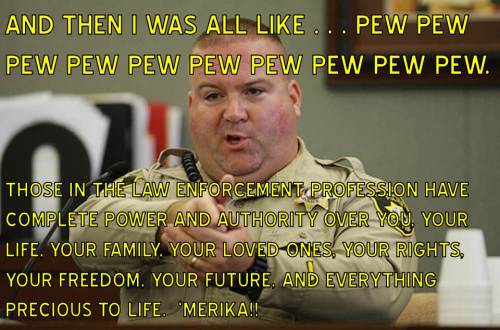
officer-safety-pew-pew-pew-complete-power

Phoenix police officer shoots dead unarmed black man during scuffle

Who writes this garbage? better yet-Why didn’t an editor edit it? 5 year olds could write better

(Reuters) – A Phoenix police officer shot to death an unarmed black man during a struggle and authorities said the officer believed the individual had a gun, in the latest fatal incident amid national turmoil over the policing of black communities.

On Thursday night, some 200 demonstrators protested against the killing of 34-year-old Rumain Brisbon, marching to Phoenix police headquarters and blocking streets, broadcaster CBS5 reported.

.

The Phoenix Police Department said Brisbon was sitting in a SUV outside a convenience store on Tuesday evening, and two witnesses told the officer the occupants of the vehicle were selling drugs.

With police forces across the country under increased scrutiny over killing unarmed black men, Phoenix police said in a statement that its officer called for backup, and then saw Brisbon appear to remove something from the car’s back seat.

It said the officer, a seven-year veteran of the department, gave him several commands to show his hands, before Brisbon “placed one or both hands in his waistband area” and fled.

The officer chased and caught up with him, it said, and during a struggle the policeman believed he felt the handle of a gun while holding Brisbon’s hand in his pocket.

“The officer gave the suspect several commands to get on the ground but he refused to comply, yelling profanities at the officer,” the police department said in a statement issued on Wednesday.

At that point, both men stumbled into an opened apartment unit, it said, adding that the officer was unable to keep a grip on the suspect’s hand.

“Fearing Brisbon had a gun in his pocket the officer fired two rounds striking Brisbon in the torso,” it said.

The police department said back-up officers arrived after the shooting, and while they and members of the fire department treated Brisbon, he was pronounced dead at the scene.

.

Police said Brisbon was carrying oxycodone pills, and that a semi-automatic handgun and a jar of what is believed to be marijuana were found in the SUV. The 30-year-old officer was not injured, police added in the statement.

The shooting in Phoenix comes at a time of tension between law enforcement officers and the communities in which they operate. Two grand jury decisions not to indict officers who killed unarmed black men in Ferguson, Missouri, and in New York City have triggered protests throughout the United States.

http://news.yahoo.com/phoenix-police-officer-shoots-dead-unarmed-black-man-054343212.html

h/t The Grey Enigma

The cops really gotta stop with the puppycide-I’ve read articles where they shot a 5# puppy because the cop said it was “acting aggressive”.

Keith Preston's avatarAttack the System

Inquistr.Com

Austin Police Dog Car
Police officers in Austin, Texas, will soon undergo training to help decrease the number of dogs shot by officers. The training will focus on teaching officers how to spot the difference between a dog that is attacking and a playful or curious dog. The department is hoping the training will help curb the number of dogs shot by police officers on their force.

According to KSAT, the training is the result of public outcry following a few high-profile dog shootings by police officers. One of the high-profile cases being the Cisco the Dog case which garnered national attention when police officer shot Cisco the dog point-blank after responding to a call at the wrong address. Another case involved the shooting of a pit bull when officers responded to an auto theft call. In the case, the dog was shot in the head and then shot a second time…

View original post 312 more words

Hundreds of Police Killings Are Uncounted in Federal Stats

FBI Data Differs from Local Counts on Justifiable Homicides

WASHINGTON—When 24-year-old Albert Jermaine Payton wielded a knife in front of the police in this city’s southeast corner, officers opened fire and killed him.

http://online.wsj.com/articles/hundreds-of-police-killings-are-uncounted-in-federal-statistics-1417577504